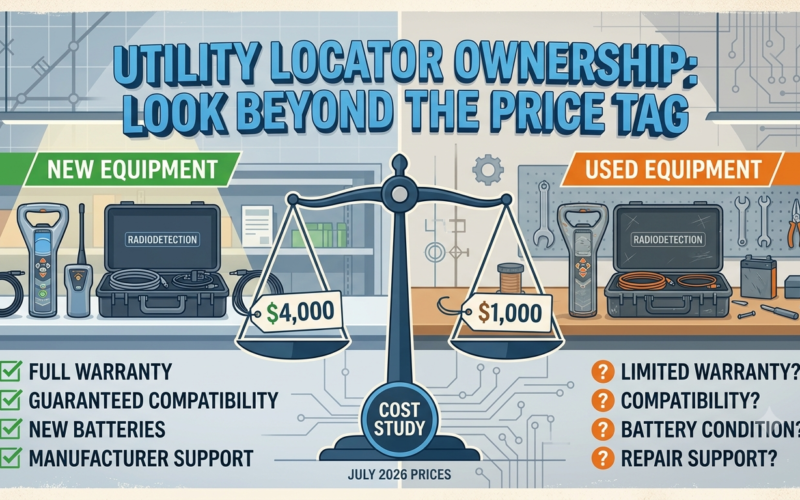
A used utility locator can cut the initial equipment cost by several thousand dollars. That doesn’t automatically make it the cheaper machine to own.
Contractors comparing new and used Radiodetection locators need to look beyond the receiver’s price. Warranty coverage, transmitter compatibility, missing accessories, battery condition, repair support, and downtime can change the total cost quickly.
This study compares advertised U.S. prices available in July 2026. It also reviews manufacturer warranty terms, current repair support, package contents, and a simple ownership-versus-rental model.
The prices below are advertised prices. They are not confirmed transaction prices or universal market values.
What We Compared
The study covers electromagnetic cable and pipe locators from three major equipment families:
- Radiodetection RD7200, RD8100, RD8200, and RD8200G;
- Vivax-Metrotech vLoc3-Pro and vLoc3 RTK-Pro;
- Subsite UtiliGuard, UtiliGuard 2, and UtiliGuard 2 RTK.
We separated receivers from complete kits. A receiver-only listing cannot be compared directly with a package that includes a transmitter, signal clamp, connection leads, charger, ground rod, and carrying bag.
We also kept different generations and variants separate. A used Radiodetection RD8100 PDL does not represent a discounted RD8200. A Subsite UtiliGuard 2 Classic receiver does not offer the same configuration as a UtiliGuard 2 RTK kit.
2026 Utility Locator Price Snapshot
The table shows selected advertised prices available in July 2026.
|
Equipment |
Condition |
Package |
Advertised price |
|
Radiodetection RD8200 |
New |
Receiver only |
$5,608 |
|
Radiodetection RD8200 + TX10 |
New |
Receiver and transmitter kit |
$9,592 |
|
Radiodetection RD8200G + TX10 |
New |
GPS receiver and transmitter kit |
$10,317 |
|
Radiodetection RD8200 + TX10 |
Used |
Receiver, transmitter, leads, clamp, ground rod, and bag |
$5,799 |
|
Radiodetection RD7200 + TX5 |
Used |
Receiver and transmitter set |
$3,999 |
|
Radiodetection RD8100 PDL |
Used |
Receiver only |
$2,199 |
|
Vivax-Metrotech vLoc3-Pro |
New |
Receiver only |
$3,290 |
|
Vivax-Metrotech vLoc3-Pro + Loc3-5Tx |
New |
Receiver and transmitter kit |
$5,530 |
|
Vivax-Metrotech vLoc3-Pro + Loc3-5Tx |
Used |
Receiver and transmitter set |
$3,149 |
|
Vivax-Metrotech vLoc3-Pro + Loc3-10Tx |
New |
Receiver and 10-watt transmitter kit |
$6,370 |
|
Vivax-Metrotech vLoc3 RTK-Pro + Loc3-10Tx |
New |
RTK receiver and transmitter kit |
$11,445 |
|
Subsite UtiliGuard 2 Classic |
New |
Receiver only |
$3,047 |
|
Subsite UtiliGuard 2 Advanced |
Used |
Receiver only |
$2,400 |
|
Subsite UtiliGuard Advanced Plus + T12+ |
Used |
Receiver and transmitter kit |
$4,499 |
|
Subsite UtiliGuard 2 RTK + T12 Advanced |
New |
RTK receiver and transmitter kit |
$12,528 |
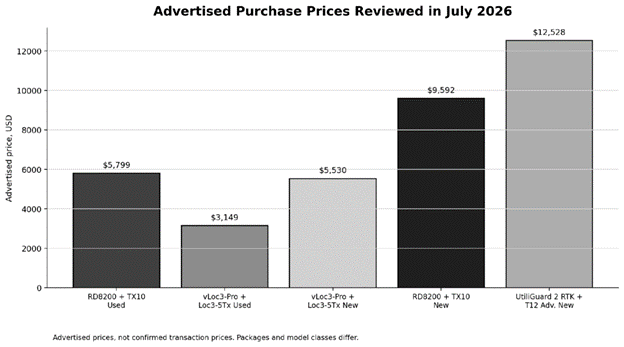
These listings show the size of the market. They do not create a universal price guide.
Condition, configuration, accessories, warranty, and seller support all affect the final value.
How Much Value Does a Used Locator Lose?
Two current listings provide a reasonable price-gap comparison between new and used packages.
Radiodetection RD8200 + TX10
The new RD8200 and TX10 kit was advertised at $9,592. A used RD8200 and TX10 kit was advertised at $5,799.
The used package cost about 60.5% of the new package price. The advertised price gap was approximately 39.5%.
The packages were not completely identical. The used listing included a new 5-inch clamp and carrying bag, while the new listing specified the receiver, TX10 transmitter, connection leads, and ground rod.
This makes the used package attractive on price. It also means the 39.5% figure is not a precise depreciation rate.
Vivax-Metrotech vLoc3-Pro + Loc3-5Tx
The new vLoc3-Pro and Loc3-5Tx kit was advertised at $5,530. A used set appeared in the UCG inventory at $3,149.
The used advertised price was about 56.9% of the new price. The difference was approximately 43.1%.
The available used listing did not provide the same level of package detail as the new product page. The calculation therefore shows a price gap, not a verified loss in value for one specific unit.
Why There Is No Universal Depreciation Rate
Utility locators do not lose value at one fixed annual rate.
The following factors can change a used locator’s value:
- exact receiver model and generation;
- transmitter output and frequency range;
- GPS or RTK capability;
- installed software options;
- battery type and condition;
- signal clamp and lead condition;
- calibration history;
- seller testing;
- warranty length;
- repair and parts support;
- cosmetic wear;
- water or impact damage.
A three-year-old current-generation locator may retain more value than a newer unit from a discontinued or difficult-to-repair family.
Age alone doesn’t set the price.
New Equipment Costs More but Reduces Unknowns
A new locator gives the buyer a known starting point.
The receiver should arrive without field wear, old battery damage, corroded contacts, weak buttons, or an unknown repair history. A complete new kit also reduces the chance that the crew will need to find a compatible charger, signal clamp, connection lead, or battery tray later.
New equipment makes the strongest ownership case when:
- the locator will work every day;
- downtime would stop excavation or drilling;
- the company needs a longer warranty;
- several crews need matching equipment;
- the customer requires documented checks;
- the company uses GPS, RTK, or data logging;
- the buyer needs current software and accessories.
The higher purchase price buys predictability. It doesn’t guarantee that the locator will never fail.
Used Equipment Reduces Capital Cost but Adds Inspection Risk
A used locator can make sense for an experienced buyer.
The discount becomes more valuable when the unit comes from a current or repairable product family. The buyer should also confirm that the seller tested the receiver and transmitter together.
Used equipment works well in several scenarios:
- the crew needs a backup locator;
- the company already owns compatible transmitters and accessories;
- the buyer can test the system before deployment;
- the seller provides a written warranty;
- the model still has repair and parts support;
- the latest GPS or mapping features are not required;
- the price difference covers the added risk.
A low price does not help when the equipment cannot complete the intended locate.
Warranty Comparison
Warranty terms create one of the clearest differences between new and used equipment.
Radiodetection
Radiodetection lists a one-year standard warranty for eligible RD8200 and RD8200SG locators and transmitters. The owner can extend the warranty to three years by registering the equipment within three months of purchase.
A specific used RD8200 and TX10 listing reviewed for this study included a 30-day seller warranty.
That difference matters. A buyer may accept a shorter warranty for a backup receiver but reject it for a primary production kit.
Subsite UtiliGuard 2
Subsite documentation lists a one-year standard warranty for the UtiliGuard 2 receiver and transmitter. Registration can add another year.
One new UtiliGuard 2 Classic seller listing stated a one-year original manufacturer warranty. The buyer should confirm whether the specific unit qualifies for the additional registered year.
A used UtiliGuard 2 Advanced receiver listing included a 30-day seller warranty.
Vivax-Metrotech
Technical documentation for the Vivax-Metrotech vLoc3-5000 lists a two-year warranty with an optional extended warranty. UCG listings for new vLoc3-Pro packages also state that the manufacturer offers a two-year warranty.
The buyer must verify the exact warranty for the model, serial number, seller, and region. Warranty terms from one vLoc3 model should not be applied automatically to every receiver in the product family.
Questions to Ask About Warranty
Before buying, confirm:
- when the warranty starts;
- whether registration is required;
- whether the registration deadline has passed;
- whether coverage transfers to a second owner;
- which accessories have shorter coverage;
- whether batteries count as consumables;
- who pays shipping for warranty service;
- what the seller covers on a used unit.
A “warranty included” statement needs details.
The Receiver Price Is Not the Complete Package Price
A receiver-only purchase may look inexpensive because the expensive accessories sit outside the listing.
A field-ready active locating kit may need:
- compatible transmitter;
- direct connection leads;
- signal clamp;
- ground rod;
- Li-ion battery;
- alkaline battery tray;
- wall charger;
- vehicle charger;
- USB cable;
- carrying bag or hard case.
For example, a new Vivax-Metrotech vLoc3-Pro and Loc3-10Tx kit listed the receiver, transmitter, battery trays, chargers, connection leads, ground stake, USB cable, bag, and batteries. The signal clamp was sold separately.
A used Radiodetection RD8200 kit reviewed for this study included a new clamp, ground rod, and bag. Another used receiver-only listing did not include a transmitter.
Compare the ready-to-work cost.
A buyer who already owns compatible accessories can save money with a receiver-only purchase. A first-time buyer may spend more assembling an incomplete used package than buying a complete kit.
Compatibility Can Change the Ownership Decision
Matching brand names do not prove compatibility.
Before buying a used locator, confirm:
- exact receiver model;
- exact transmitter model;
- supported active frequencies;
- direction-identification functions;
- clamp frequency support;
- battery and charger type;
- Bluetooth or GPS options;
- software configuration;
- regional frequency limitations;
- data-export requirements.
Radiodetection RD7200, RD8100, RD8200, and RD8200G belong to related product families, but they do not offer identical functions.
Subsite also separates Standard, Classic, Advanced, Advanced Plus, and RTK configurations. A low-price Standard receiver should not be compared with an RTK kit as though only the condition changed.
Vivax-Metrotech vLoc3-Pro and vLoc3 RTK-Pro serve different ownership needs. The RTK model carries a much higher acquisition cost because the buyer is paying for mapping functions, not only basic cable and pipe location.
Compatibility requires confirmation from the manufacturer or equipment supplier.
Repairability Matters More Than Cosmetic Condition
A scratched case can still protect a functional receiver. A clean case can hide a weak transmitter output, corroded battery contacts, or a failing keypad.
The buyer should prioritize electrical and operational condition.
Current UCG repair pages list support for several relevant families:
- Radiodetection RD7000, RD8000, RD8100, RD7200, RD8200, RD8200G, TX1, TX3, TX5, TX10, and TX10B;
- Vivax-Metrotech vLoc and vLoc3 receivers, including vLoc3-Pro, vLoc3-5000, vLoc3 RTK-Pro, Loc3-5Tx, and Loc3-10Tx;
- Subsite UtiliGuard, UtiliGuard 2, T5, and T12 families.
That support improves the ownership case for used equipment. It does not establish a fixed repair cost.
The reviewed sources did not provide a reliable public price matrix for:
- screen repair;
- keypad replacement;
- connector repair;
- transmitter-output repair;
- water damage;
- calibration failure;
- battery-contact corrosion.
The article should not assign an average repair cost without diagnostic data.
Calibration and Functional Checks
A locator can power on and still give unreliable information.
Radiodetection describes the RD8200 as safety-related equipment that should receive regular checks. The company’s eCert function tests the locating circuitry and can issue a calibration certificate after a successful test.
RD8200 equipment can also use CALSafe. When enabled, this function can stop the locator after its expected service or calibration date.
These functions improve equipment control, especially across a fleet. They do not replace a practical field check.
Before placing a used locator into service, test:
- passive Power and Radio modes;
- active direct-connection mode;
- transmitter output levels;
- signal clamp response;
- current measurement;
- depth response over a known test line;
- receiver buttons and audio;
- display visibility in sunlight;
- charger and battery operation;
- GPS, Bluetooth, or RTK functions where fitted.
The crew should also inspect the housing, connector ports, battery compartment, seals, and serial-number label.
What Downtime Can Cost
The purchase price appears once. Downtime can appear throughout the ownership period.
A failed primary locator can delay:
- excavation;
- HDD pilot-bore setup;
- potholing;
- utility verification;
- customer handoff;
- crew scheduling.
The actual cost depends on labor rates, crew size, equipment on site, subcontractor commitments, and project deadlines.
No reviewed source provides a universal downtime cost for a failed locator. A contractor should calculate it from the company’s own operation.
Use this structure:
Downtime cost = idle labor + idle equipment + rental replacement + travel + schedule impact
A company that can replace a failed locator from its own fleet carries less risk than a small crew with one receiver.
When Does Buying Beat Renting?
A rental price provides one practical way to estimate break-even.
A Radiodetection RD8200 kit was advertised for rent at:
- $599 for one month;
- $499 per month for two or more months;
- $4,000 security deposit.
A simple break-even formula is:
Break-even months = purchase price ÷ avoided monthly rental cost
Using the $599 one-month rate:
|
Purchase |
Price |
Simple break-even |
|
Used Radiodetection RD8200 + TX10 kit |
$5,799 |
9.7 months |
|
New Vivax-Metrotech vLoc3-Pro + Loc3-5Tx kit |
$5,530 |
9.2 months |
|
New Radiodetection RD8200 + TX10 kit |
$9,592 |
16.0 months |
|
New Subsite UtiliGuard 2 RTK + T12 Advanced kit |
$12,528 |
20.9 months |
Using the $499 multi-month rate:
|
Purchase |
Price |
Simple break-even |
|
Used Radiodetection RD8200 + TX10 kit |
$5,799 |
11.6 months |
|
New Vivax-Metrotech vLoc3-Pro + Loc3-5Tx kit |
$5,530 |
11.1 months |
|
New Radiodetection RD8200 + TX10 kit |
$9,592 |
19.2 months |
|
New Subsite UtiliGuard 2 RTK + T12 Advanced kit |
$12,528 |
25.1 months |
This is not a complete return-on-investment calculation.
The model excludes:
- repair costs;
- financing;
- taxes;
- shipping;
- calibration;
- missing accessories;
- resale value;
- insurance;
- downtime;
- rental availability.
It also compares different equipment classes against one RD8200 rental benchmark. Use it to understand utilization, not to rank every model directly.
A More Complete Ownership Formula
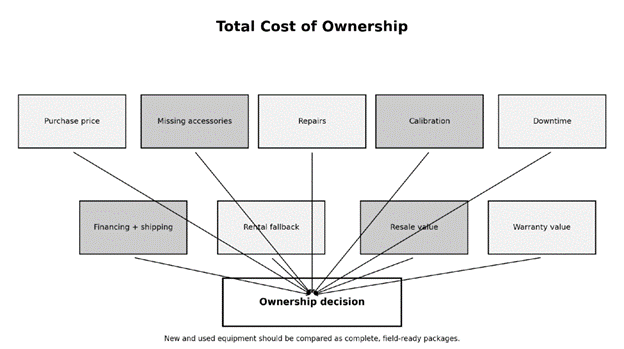
A contractor can compare options with this formula:
Total ownership cost = purchase price + accessories + repairs + calibration + financing + replacement rental − resale value
The buyer should estimate each item over a defined period, such as three or five years.
Example Inputs
For a new locator:
- higher purchase price;
- longer warranty;
- fewer early repairs;
- complete accessories;
- higher expected resale value.
For a used locator:
- lower purchase price;
- shorter warranty;
- possible missing accessories;
- greater repair uncertainty;
- lower capital at risk.
The result depends on the actual unit.
When to Buy New
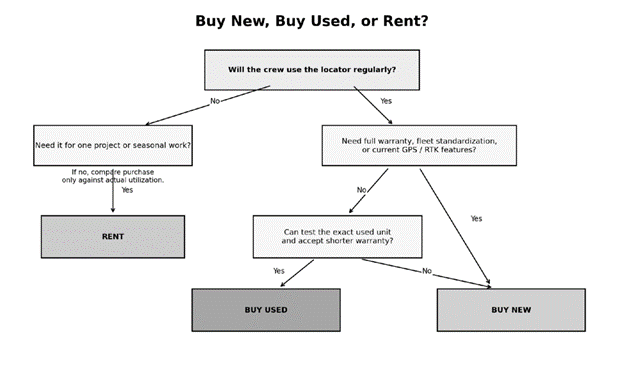
Buy new when the company needs predictable operation more than the lowest purchase price.
New equipment fits best when:
- the receiver serves as the primary locator;
- crews use it every week;
- a failed locator would stop production;
- warranty length affects the decision;
- the company needs current GPS or RTK features;
- customers require data records;
- the fleet manager wants standard batteries and accessories;
- the buyer cannot inspect used electronics properly.
New equipment also makes sense when the used discount is small. A 10% or 15% reduction may not justify a short warranty and unknown history.
When to Buy Used
Buy used when the price reduction covers the additional risk.
A used locator fits best when:
- the seller tested the receiver and transmitter;
- the exact model still has repair support;
- the buyer receives a written condition report;
- the buyer can verify every function;
- the kit includes the required accessories;
- the crew already owns compatible equipment;
- the unit will serve as a backup;
- the company accepts a shorter warranty.
A current-generation used locator can provide better value than a new entry-level receiver. The comparison still needs to follow the work requirement.
When to Rent
Rent when the project does not support regular ownership.
Rental may fit when:
- the crew needs a locator for one project;
- the company wants to test a model before buying;
- the primary locator is under repair;
- workload changes by season;
- a specialized RTK or mapping configuration is needed temporarily;
- the company cannot support calibration and storage.
Rental removes the resale problem. It also creates recurring cost and depends on equipment availability.
Used Locator Inspection Checklist
Before paying for a used locator, check the following items.
Model and Identity
- full model name;
- receiver variant;
- serial number;
- transmitter model;
- software version;
- installed options;
- GPS or RTK capability.
Physical Condition
- housing cracks;
- screen damage;
- worn or sticking buttons;
- damaged antenna section;
- corroded battery contacts;
- loose connectors;
- missing port covers;
- signs of water entry;
- damaged charger ports.
Package Contents
- receiver;
- transmitter;
- signal clamp;
- direct connection leads;
- ground rod;
- battery trays;
- Li-ion batteries;
- chargers;
- USB cable;
- bag or case;
- manuals.
Functional Checks
- passive locating;
- active frequencies;
- transmitter output;
- direct connection;
- clamp induction;
- depth;
- current;
- audio;
- display backlight;
- charging;
- GPS, Bluetooth, or RTK;
- self-test or calibration status.
Commercial Checks
- seller warranty;
- return conditions;
- repair support;
- parts availability;
- shipping terms;
- previous repair records;
- proof that the unit was tested.
Do not buy from the model name alone.
Final Cost Comparison
|
Factor |
New locator |
Used locator |
|
Initial price |
Higher |
Lower |
|
Manufacturer warranty |
Usually strongest |
May be expired or non-transferable |
|
Seller warranty |
Secondary |
Often short |
|
Condition history |
Known starting point |
May be incomplete |
|
Accessories |
Predictable in full kit |
Must be checked individually |
|
Repair risk |
Lower during early ownership |
Higher uncertainty |
|
Latest software and features |
More likely |
Depends on model and configuration |
|
Fleet standardization |
Easier |
Harder with mixed generations |
|
Capital at risk |
Higher |
Lower |
|
Value as a backup unit |
Expensive option |
Often strong use case |
Key Findings
Used utility locators can reduce advertised purchase cost by around 40% in the comparable Radiodetection RD8200 and Vivax-Metrotech vLoc3-Pro examples reviewed.
That figure is a price-gap snapshot, not an annual depreciation rate.
New equipment usually provides longer warranty coverage, clearer package contents, and less uncertainty around batteries, repairs, calibration, and software.
Used equipment creates the strongest value when the buyer can test it, confirm compatibility, and access repair support.
Receiver-only prices can mislead. Always calculate the cost of the complete field-ready package.
A simple rental comparison suggests that ownership can break even after roughly 9–16 months for several standard kits. Full return on investment depends on repair, resale, downtime, financing, and utilization.
The final choice follows the operating scenario:
- buy new for daily production, standardization, warranty, and current mapping features;
- buy used for backup equipment or lower-cost ownership when condition is verified;
- rent for temporary, seasonal, or specialized work.
The lowest purchase price is not always the lowest ownership cost.
Also Read: