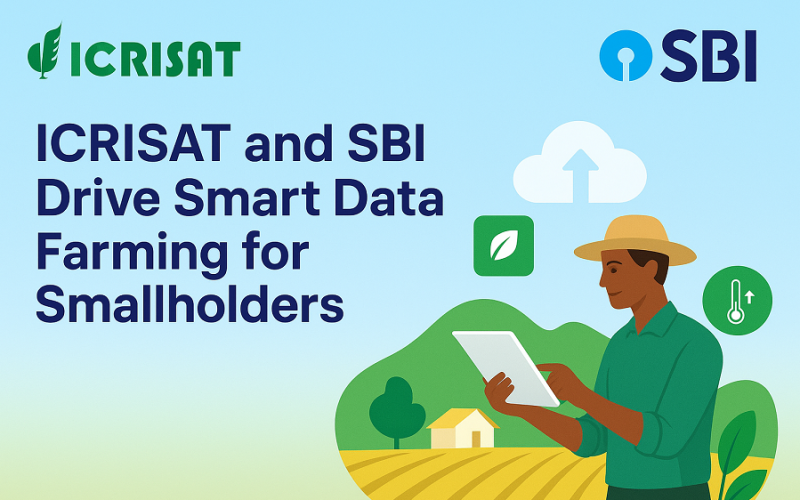
A major initiative in smart data farming has been launched. The SBI Foundation, together with the International Crops Research Institute for the Semi‑Arid Tropics (ICRISAT) and the University of Agricultural Sciences, Raichur (UAS Raichur), announced the three-year project named SMART‑CROP (Sustainable Monitoring and Real-time Tracking for Crop Resilience and Optimal Practices). This move promises to bring a new dimension to smart data farming by integrating advanced technologies in agriculture.
What the initiative involves
The SMART-CROP project will cover more than 8,000 smallholder farmers in select districts of Karnataka (Bidar, Kalaburagi, Raichur) and Telangana (Sangareddy, Vikarabad). Under the CSR programme LEAP (Livelihood and Entrepreneurship Accelerator Programme) of SBI Foundation, the initiative aims to reinforce the resilience and productivity of farmers through smart data farming.
The project deploys satellite imaging, remote sensing, and AI/ML-driven analytics to enable real-time monitoring of crops.
The system will detect crop stress caused by pests, diseases, adverse weather or soil health issues — allowing farmers to act before damage deepens.
Also Read – Soil Quality Analysis for Smart and Sustainable Farming
Focus and methodology
The focus is primarily on pulse crops such as chickpea and pigeonpea, which are vital for nutrition and livelihoods in the semi-arid regions.
With the help of digital tools and farmer engagement, SMART-CROP will incorporate participatory methods and socio-economic assessments to determine yield gaps and benefits of early detection frameworks.
Key steps include:
- Early detection of crop stress through remote sensing and AI models.
- Alerts and actionable insights provided to farmers for timely interventions.
- Training and digital inclusion for farmers so they can interpret data and apply best practices.
Impact and significance
By enabling smart data farming, the project aims to reduce crop losses, improve soil health, enhance productivity and ensure farming systems are more resilient to climate and pest shocks.
According to Dr Mamta Sharma at ICRISAT, nearly 40% of global crop losses stem from pests and diseases — underlining the urgency of technology-led monitoring.
The collaboration highlights how institutional synergy between SBI Foundation, ICRISAT and UAS Raichur can provide a replicable model for sustainable agriculture in drylands.
Conclusion
In sum, the SMART-CROP initiative marks a clear step towards embedding smart data farming into smallholder agriculture in India. The integration of satellite technology, AI/ML analytics and grassroots training sets a new benchmark for climate-resilient farming. As the project evolves over the next three years, its outcomes may serve as a blueprint for similar efforts nationwide.
What are your thoughts on this blend of technology and agriculture? Share your views or questions below — I’d love to hear how you think smart data farming can be scaled further.
Source: ICRISAT