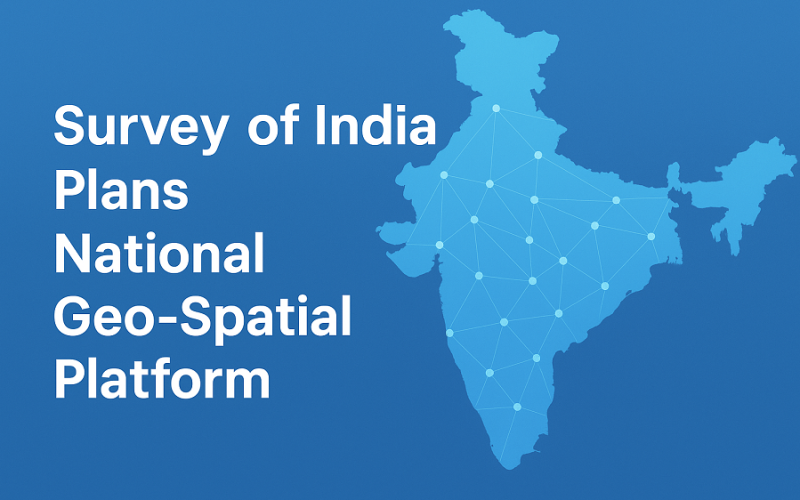
The Survey of India (SoI) has signed a key agreement with C.E. Info Systems Pvt. Ltd. to build a cutting-edge national geo-spatial platform. This initiative is a central pillar in delivering the vision of the National Geospatial Policy, 2022, aimed at enabling geospatial data access and usage across governance, industry, academia and citizen services.
Explain – What is the platform and why it matters
The new national geo-spatial platform will serve as a unified digital infrastructure. It will aggregate, harmonise and disseminate authoritative foundational geospatial datasets — such as ortho-rectified imagery, digital elevation models (DEM), administrative boundaries, and geodetic reference frames. The objective is to promote interoperability of spatial data via web-services, APIs and mobile apps — thereby enabling a data-driven, spatially enabled economy.
The platform addresses critical needs. For example, infrastructure planning under Gati Shakti, disaster management, and citizen-centric services demand high-precision spatial information. By creating a single source of truth, decision-making can be faster, more accurate and transparent.
Also Read – Survey of India Launches Web Portal to Download Maps
Examples – Key components and how they will work
The platform’s architecture includes an Integrated Geospatial Application Interface (IGAI), a Spatial Data Registry (SDR) for metadata management, and a geospatial data integration & dissemination system. For instance, ministries and departments can access standardised imagery and models via APIs rather than procuring disparate data sets.
In practical terms, this means a development agency planning a highway can pull DEM layers and satellite imagery directly from the national geo-spatial platform rather than commissioning separate surveys. Similarly, a start-up in the geospatial analytics space can build services on top of these baseline datasets, fostering innovation and private-sector participation.
Take-away – Why this matters for India
The rollout of the national geo-spatial platform signals a shift in India’s geospatial ecosystem from fragmented data silos to a unified, open and collaborative framework. It aligns strongly with the National Geospatial Policy, 2022 which designates publicly funded geospatial data as a “common good”. This opens doors for streamlined governance, better urban and rural planning, and enhanced private-sector engagement in applications like precision agriculture, smart cities and environmental monitoring.
Action – What happens next
Stakeholders across government, academia and industry should prepare to engage with the platform. Ministries need to integrate their workflows to leverage shared geospatial services. Research institutions and start-ups should monitor for access opportunities to build applications atop the platform. Citizens too stand to gain through better-informed services and infrastructure. As the national geo-spatial platform becomes operational, early adopters will gain a strategic advantage in spatially enabled decision-making.
In summary, the Survey of India’s launch of the national geo-spatial platform represents a foundational step toward a truly spatially enabled digital economy. The unified infrastructure promises to drive innovation, improve governance, and make geospatial intelligence institutionally accessible. Stakeholders who engage early will benefit from the clarity and efficiency the platform offers.
Source: Press Information Bureau