NASA ARSET Training on Solar-Induced Fluorescence Monitoring for Vegetation
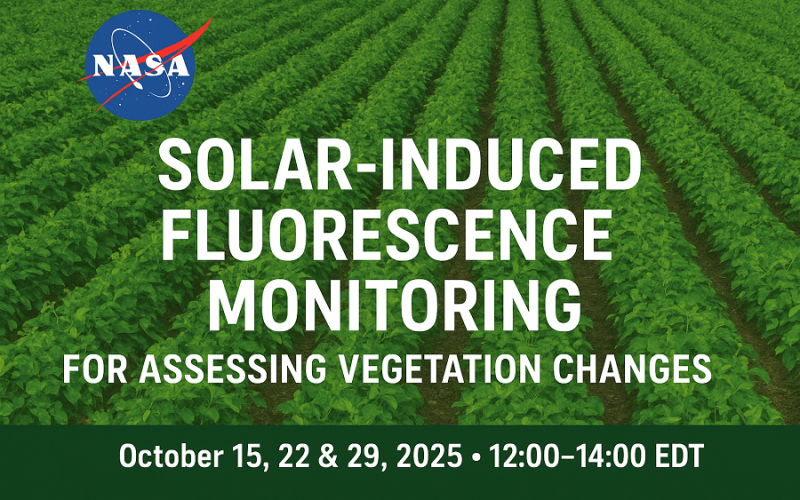
NASA’s Applied Remote Sensing Training (ARSET) program has announced a new online course focused on solar-induced fluorescence monitoring, designed to enhance understanding of vegetation dynamics under changing environmental conditions. The training will take place on October 15, 22, and 29, 2025, from 12:00 to 14:00 EDT (UTC-4).
Training Overview
The course, titled Solar Induced Fluorescence (SIF) Observations for Assessing Vegetation Changes Related to Floods, Drought, and Fire Impacts, introduces participants to the principles and applications of SIF remote sensing. By measuring faint light emitted by plants during photosynthesis, SIF provides insights into ecosystem health, productivity, and stress responses.
This training highlights the importance of solar-induced fluorescence monitoring in tracking crop cycles, identifying agricultural drought impacts, and evaluating vegetation recovery after wildfires. Participants will also explore how SIF data can be linked to Gross Primary Production (GPP), a key measure of ecosystem productivity.
Also Read – Solar Induced Chlorophyll Fluorescence – A Better Predictor of Crop Stress through Satellite Remote Sensing
Hands-On Applications
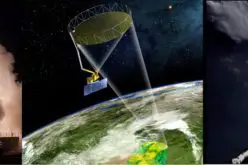
Beyond theory, the course emphasizes practical learning. Attendees will analyze SIF datasets from NASA’s Orbiting Carbon Observatory-2 (OCO-2) and Orbiting Carbon Observatory-3 (OCO-3) missions. These datasets are vital for understanding vegetation patterns across cropland and natural systems worldwide.
The program also introduces gap-filled data products derived through machine learning, offering advanced tools for interpreting incomplete satellite records. These resources will allow participants to assess environmental impacts with greater accuracy and confidence.
Significance and Impact
The relevance of solar-induced fluorescence monitoring has grown in recent years as climate change drives more frequent floods, droughts, and wildfires. By equipping researchers, practitioners, and policymakers with new skills, NASA aims to strengthen the ability of global stakeholders to monitor and respond to environmental stressors.
The training is open to participants worldwide and requires no prior technical background, making it accessible to a diverse audience. With its combination of scientific foundations and hands-on exercises, the course offers a comprehensive introduction to one of the most advanced techniques in vegetation monitoring.
Registration and Participation
Interested individuals can register through NASA’s Earthdata website. Participation is free, but spaces may be limited due to high demand. Recordings and materials will also be made available for those unable to attend live sessions.
By expanding access to tools like solar-induced fluorescence monitoring, NASA continues to support evidence-based decision-making for agriculture, forestry, and environmental management. The training promises to bridge scientific innovation with real-world application, helping communities adapt to an era of rapid ecological change.